
Written by Andrew Rollins, Francisco Vera, and Sam Foth.
Three weeks ago, UCF Men’s Basketball upset then-ranked #11 Texas Tech and were hoping to see themselves in the top 25 once again. Fast forward to the present day, and the Knights are on a three-game losing streak, showing signs of a pre-March Madness collapse.
The beginning of this losing streak was against #2 Houston, where the biggest difference maker in this game was the turnovers and field goal percentage differential, which resulted in a final score of 55-79 in favor of the Cougars.
From the field, UCF shot 31%, compared to Houston’s 55%. The Cougars turned the ball over five times while the Knights struggled to keep hold of the ball, turning it over 11 times. Houston also dominated the board, putting up 40 rebounds compared to UCF’s 29.
What followed was another 20-point loss, this time against the Cincinnati Bearcats. The struggles for the Knights stemmed from their inability to hit shots and contest them. UCF shot 41% from the field and 26% from three while allowing the Bearcats to shoot 59% from the field and 61% from three.
A big storyline of this game was Themus Fulks, who plays an average of 32 minutes a game while averaging 14 points and 7 assists, only played 19 minutes against the Bearcats, and was held scoreless with only two assists.
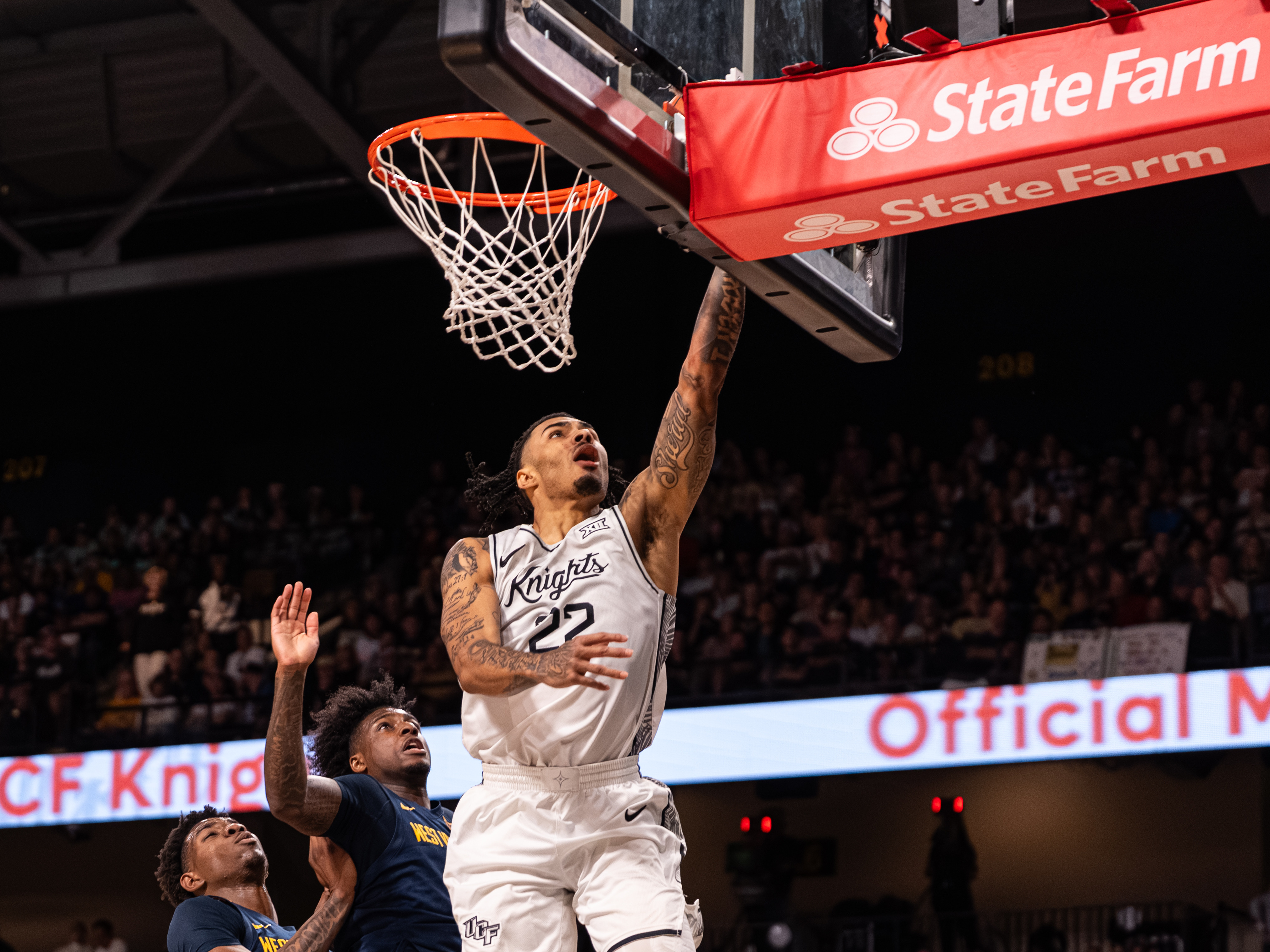
Most recently, the heartbreak against West Virginia on Valentine’s Day, where the Knights led by 14 points with 13 minutes remaining. However, later in the second half, they lost most of their momentum, and the Mountaineers evened the score.
A 10-0 run gave West Virginia the lead with just a minute left in the game. UCF attempted one final comeback, but it wasn’t enough, and the Mountaineers emerged victorious.
The Knights are now 17-7 overall, and 6-6 in conference play with six games left in the regular season. Three of the remaining opponents are currently in the bottom half of the Big 12 (Utah, Baylor, and Oklahoma State). They also have one final ranked matchup against #23 BYU.
The two other opponents are TCU, whom they play at home next on February 17th, and a rematch against West Virginia to cap off the regular season.
Regardless of what recent results have shown, UCF still controls its own destiny, and it is solely up to them to see whether or not they will have a higher seed for the Big 12 tournament and ultimately reach the Big Dance.
If the Big 12 tournament were to start today, the Knights would begin the tournament in the second round on March 11th as the eighth seed. They would face the winner of game two, which in this case is the ninth seed, TCU, against the 16th seed, Utah.
If UCF wins their first matchup, they move on to face the number one seed, Houston. Currently sitting at 11-2 in the Big 12 and 23-3 overall.
As it was discussed in our previous Bracketology article, the remainder of the tournament would be determined on-site as the winner of every matchup after the quarterfinals moves on until there are only two teams left fighting for the Big 12 Championship and an automatic bid to the Big Dance.
Regarding March Madness, CBS Sports currently has them ranked as a 10th seed in the South region, facing the seven-seed Utah State. ESPN’s Joe Lunardi also has them as a 10th seed, but in the East region, facing the seven-seed Clemson.
As the final stretch of the regular season is approaching, it is safe to say that anything can happen in the landscape of college basketball. There is still around a month left until conference champions are crowned, and the March Madness bracket is finalized.