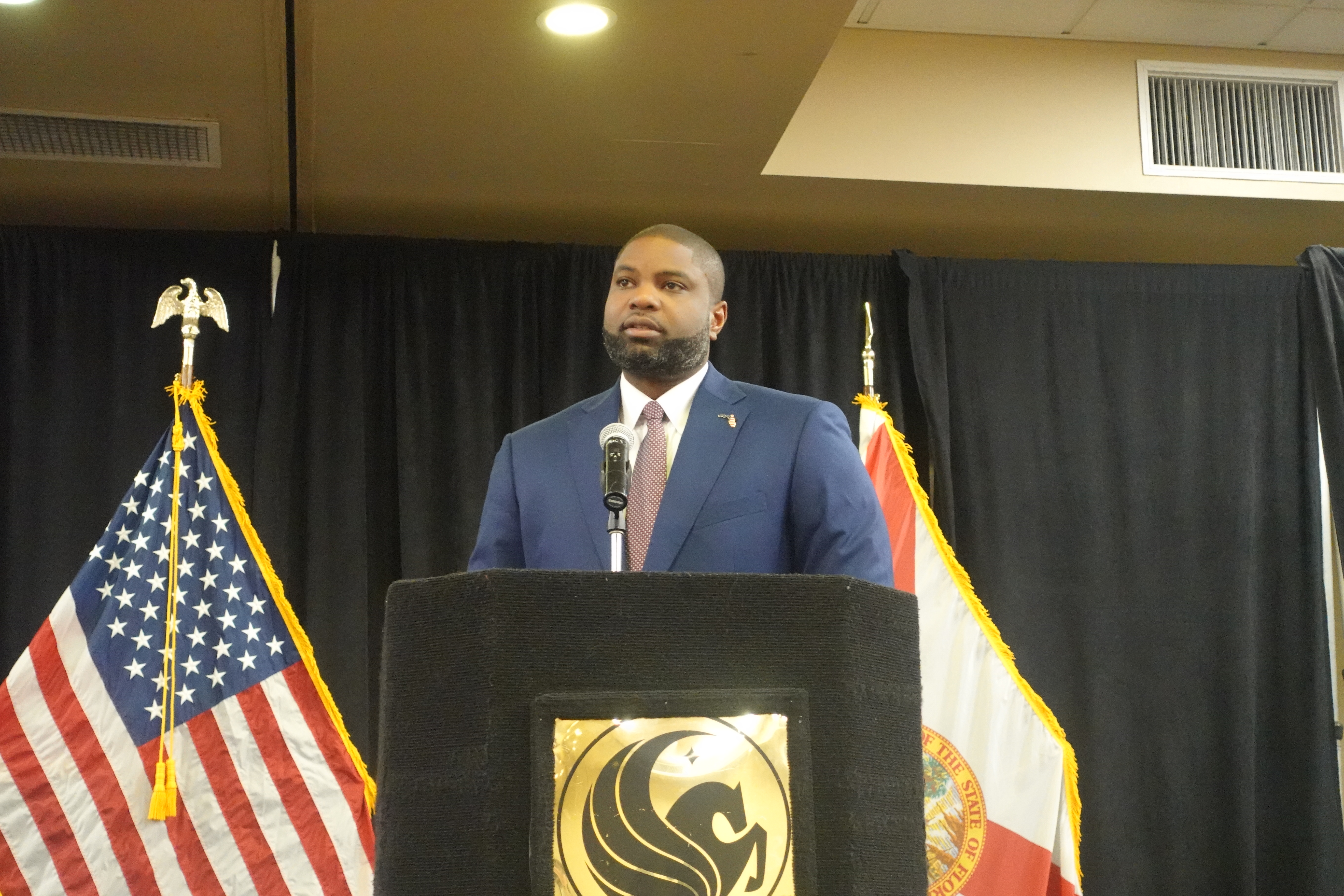
The UCF Chapter of Turning Point USA (TPUSA) hosted Congressman Byron Donalds for a remembrance of Charlie Kirk and a Q&A session with UCF Students about policy issues.
TPUSA leaders Kyle Christy and Kyle Troy opened the event, acknowledging that Charlie Kirk deeply admired Byron Donalds.
Donalds’ wife, Erika Donalds, then spoke more deeply about the relationship Kirk and Donalds had together. She then introduced her husband to the stage.
Byron Donalds began by citing Kirk as someone who was dedicated to seeing the political conservative movement grow. Donalds said that Kirk is “more missed today than people realize.”
After some brief remarks about Charlie Kirk, Byron Donalds opened the floor for questions from the audience. Knight News had the chance to ask Congressman Donalds a question. We wanted to ask a question that concerns the UCF community, and with the recent protests surrounding the 287(g) agreement that the university has with Immigration and Customs Enforcement (ICE), we decided to ask him about his approach to the agreement and what his plans will be for it as governor of Florida.
The ICE 287(g) Program is a program that allows U.S. Immigration and Customs Enforcement (ICE) to partner with local law enforcement agencies to allow the agencies to perform specific federal immigration duties. Cooperating agencies are trained and monitored by ICE.
We specifically asked if he, as governor, will continue to mandate Florida universities to comply with the 287(g) agreement, and if he believes that giving a local police officer (such as those in universities) the authority of a federal immigration officer could potentially blur the lines of authority of a local police officer.
In response, Donalds stated that it is now state law that “local law enforcement agencies will follow and fully cooperate with 287(g).” It is worth noting that under Florida Statute § 908.11, a sheriff or chief correctional officer who operates a county detention facility is mandated to enter into a written agreement with ICE.
However, Florida Statute § 908.104 only requires that local law enforcement agencies (which include university police) “use best efforts to support the enforcement of federal immigration law.” This does not necessarily entail that local law enforcement agencies must fully cooperate with the specific contractual agreement of 287(g).
Donalds said that he would not allow local law enforcement agencies to not comply with 287(g).
He then questioned the position of local law enforcement for not complying with 287(g) by asking, “At what point are you now nullifying the United States Constitution?” Donalds cited that all of the states agree to the constitutional framework of the United States, which includes “enumerated powers in there, immigration being one, that are directly given to the federal government.”
This statement is factually incorrect. An enumerated power is a power that is granted to the federal government as explicitly written in the U.S. Constitution. Our Constitution does not explicitly mention immigration as a power. The closest mention comes in Article I, Section 8, Clause 4, which highlights naturalization as an explicit power, but the process through which one becomes a citizen (naturalization) and the power to control borders, admit foreigners, and deport (immigration) are not the same.
Donalds finished his response with his view that “every local jurisdiction and every state jurisdiction within the United States has a constitutional responsibility to comply with 287(g).”
Constitutionally speaking, this is not the case. The Supreme Court ruled in New York v. United States (1992) that the federal government cannot compel a state to follow a strictly federal responsibility/act, also known as the anti-commandeering doctrine. The 287(g) agreement is a Memorandum of Agreement (MOA), which means that it is a voluntary agreement that states can enter into and are not necessarily required by the Constitution to comply with, as there are several states within the nation that do not follow 287(g).
Byron Donalds faces Democratic nominee David Jolly for governor of Florida. Election day is Tuesday, November 3rd, and the early voting period begins on Saturday, October 24th. The voter registration deadline for this cycle is on Monday, October 5th.